
FOODSCAPE WALKING ROUTES OF PICO ISLAND
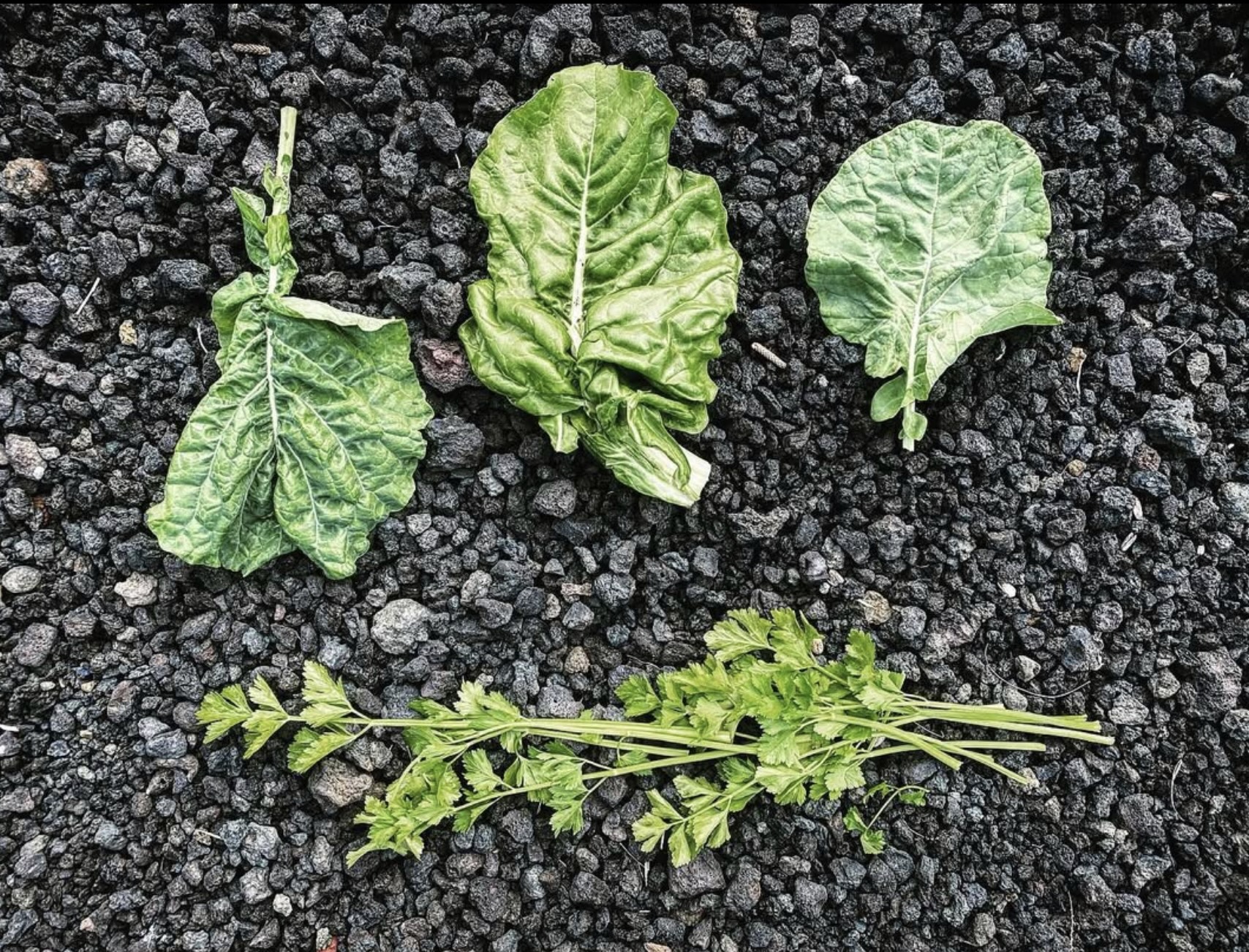
Landscapes are not only seen. They are walked, cultivated, narrated — and eaten.
Anthropologist Arjun Appadurai famously described food as a “highly condensed social fact” (Appadurai, 1981), meaning that food carries within it systems of value, memory, hierarchy, and exchange. Through food, we can read social structures, migration histories, ecological adaptation, and political power. Food is never only nourishment; it is a map of relationships.
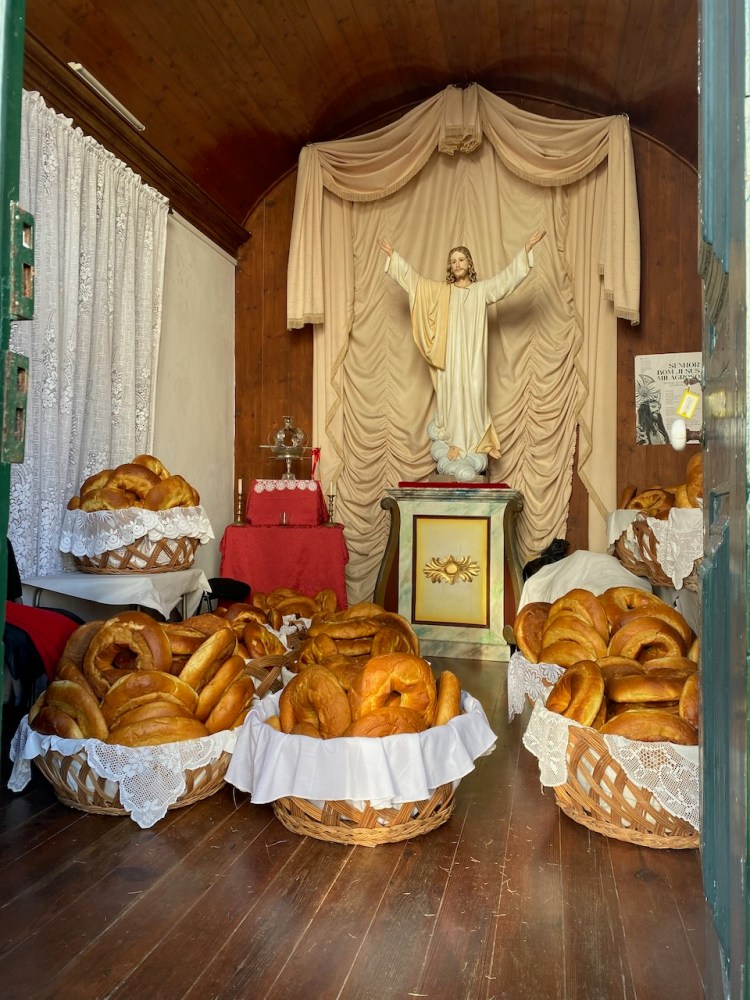
Holy Spirit Festivities in Pico island (2024)
Similarly, anthropologist Tim Ingold (1993) invites us to rethink landscape not as a static background but as a taskscape — a field of ongoing activities shaped by human and non-human practices over time. Landscape, in this sense, is processual. It is made through work, care, movement, and repetition.
When we bring these perspectives together, the concept of the foodscape emerges — a way of understanding territory as the intersection of ecology, culture, economy, and everyday practice. A foodscape is not simply where food grows. It is where meaning grows.
Islands intensify this relationship. Limited resources, ecological constraints, migration histories, and seasonal cycles make the connection between survival and landscape more visible. Nowhere is this clearer than in Ilha do Pico — a volcanic island where stone, salt, wind, and scarcity have shaped both cultivation and cuisine.
The Observatory Lab begins from this premise: that Pico can be read, understood, and reimagined through its edible landscape.
Food as a way of reading the landscape
Food as Culture, Power, and Memory
To speak about food is to speak about social life itself.
In his influential essay on gastro-politics, Arjun Appadurai (1981) argued that food is not simply a material substance but a “highly condensed social fact.” What we eat, how we prepare it, who cooks, who serves, and who is invited to the table — these are never neutral gestures. They reflect hierarchies, values, access to resources, and symbolic distinctions. Food organizes belonging. It marks inside and outside. It encodes memory.
In many societies — and particularly in island contexts — food also registers histories of scarcity and adaptation. When resources are limited, culinary practice becomes inventive. Substitution, improvisation, and experimentation become survival strategies. Over time, these strategies solidify into tradition.
What may appear today as marginal — a wild green growing at the edge of a field, a medicinal infusion remembered by an elder — often carries within it a genealogy of necessity.
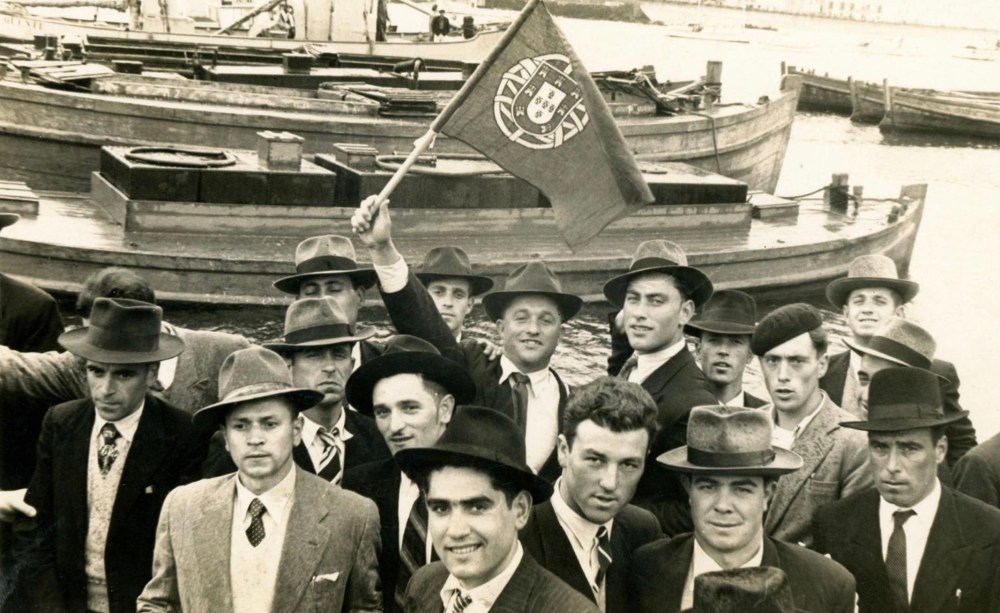
Azorean migrants in Montréal – José-Louis Jacome’s personal collection.
Appadurai’s insight is especially relevant in territories shaped by migration. Food travels. Recipes migrate. Seeds cross oceans. Techniques are adapted to new ecologies. In Pico, histories of emigration and return have influenced not only the social fabric but also culinary repertoires. The island’s foodscape is therefore not isolated; it is Atlantic.
Food also mediates power. Which plants are recognized as “valuable”? Which are dismissed as weeds? Which are associated with poverty? Which are rebranded as gourmet?
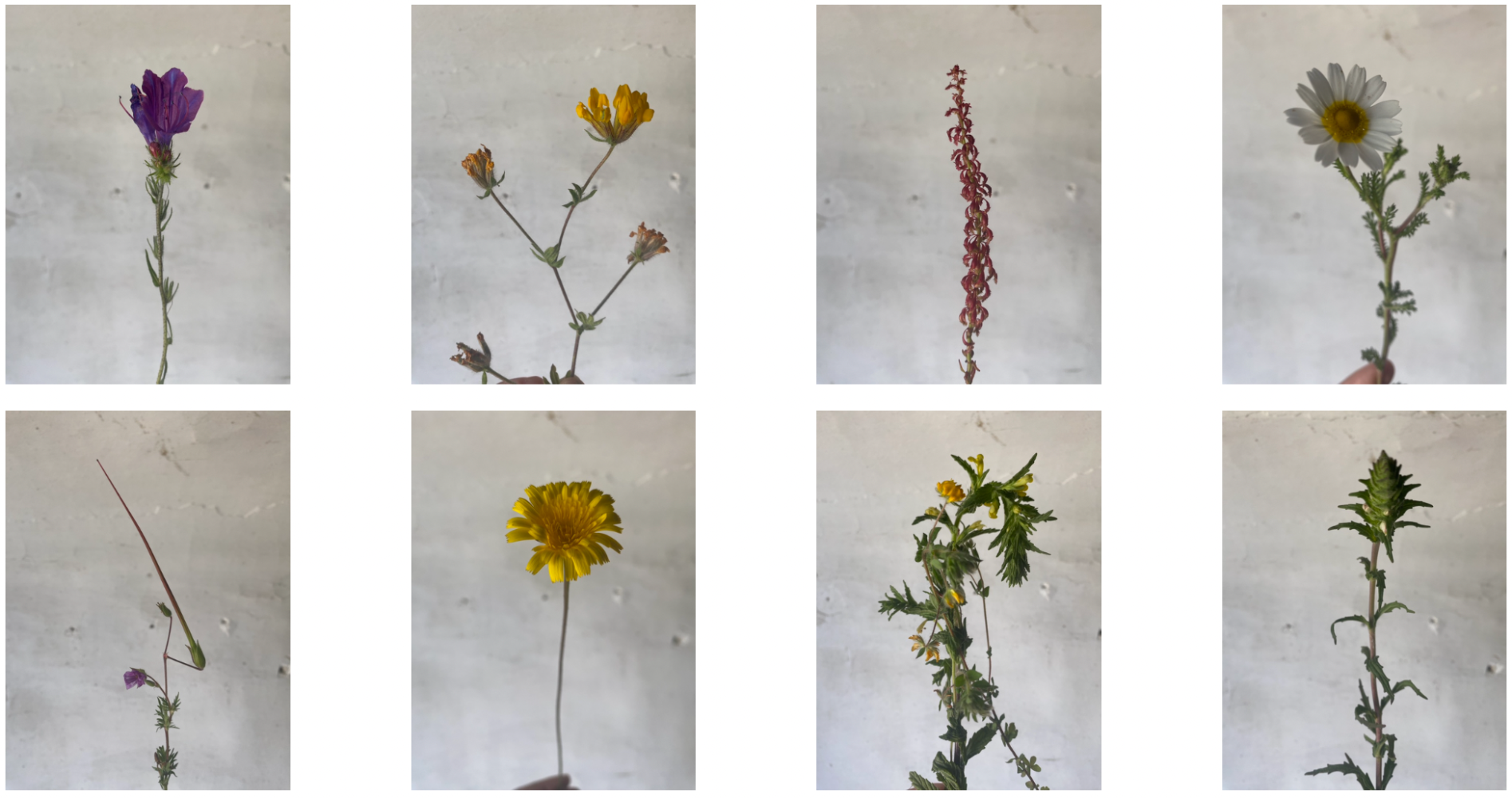
Wild Edible Plants
Wild edible plants often occupy ambiguous positions. Historically essential during hardship, they may later be stigmatized as signs of deprivation — only to be rediscovered in contemporary gastronomy as markers of authenticity or sustainability.
To work with wild plants today is therefore not merely botanical. It is cultural and political.It requires sensitivity to memory, dignity, and transformation.
For us, this understanding shapes the Observatory Lab from the beginning. We do not approach spontaneous plants as exotic curiosities or as trendy ingredients. We try to approach them as nodes in a network of relationships — ecological, historical, and emotional.
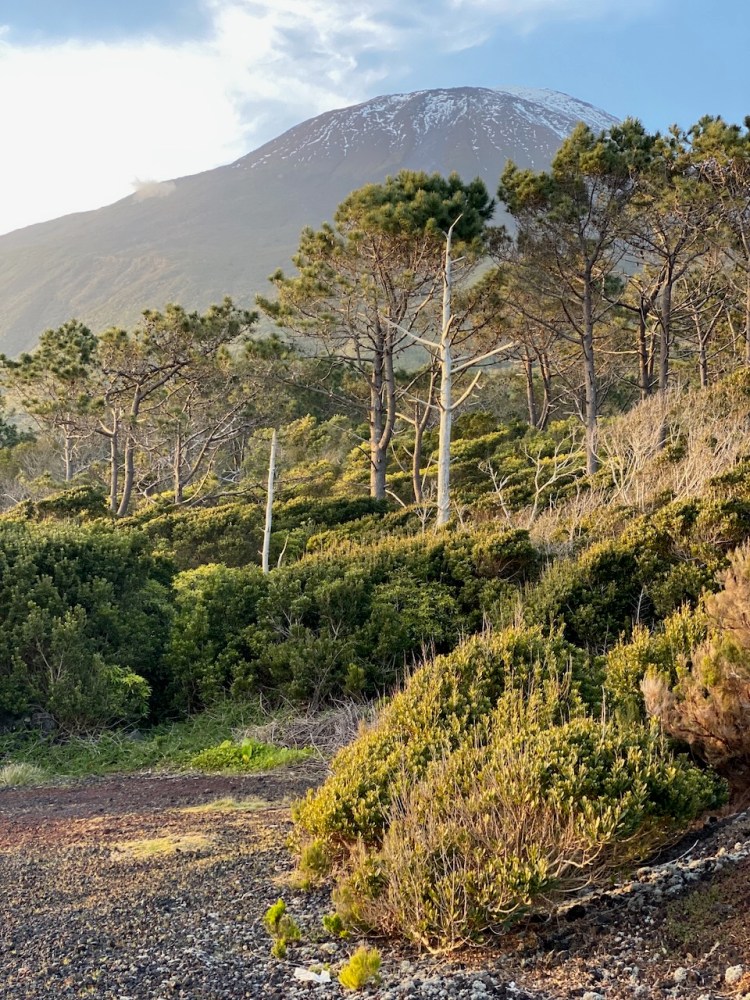
Pico Island (March 2025)
Food is therefore memory embodied. It is history digested. And on an island like Pico, where volcanic constraint and Atlantic openness coexist, food becomes a particularly powerful lens through which to understand the landscape. From here, the question naturally follows: If food reveals social relations, and if landscape is shaped by practice, then how do we enter this relationship?
For us, one answer is walking.
Walking as Knowledge, Walking as Construction
Ingold’s understanding of landscape as taskscape (1993) deeply informs how we think about walking. For him, walking is not merely displacement; it is a way of participating in ongoing processes. Through walking, we learn gradients of humidity, soil texture, exposure to wind, and seasonal shifts. Knowledge enters through the body.
Whenever I reflect on this, we are reminded of a book that was a relevation and suggested by an friend architect years ago: Walkscapes: Walking as an Aesthetic Practice by Francesco Careri.
Careri traces walking from prehistoric nomadism to contemporary artistic practices, showing how walking is not simply movement across space but an act that produces space. Pilgrimage routes, Dadaist wanderings, Situationist dérives — all reveal walking as a way of narrating and constructing territory.
What resonates profoundly with us is Careri’s insistence that walking does not merely cross landscape; it inscribes meaning into it.
In Pico, this insight feels immediate. A narrow path between basalt walls is not only a route. It carries agricultural labor, seasonal rhythms, migration departures, and return stories. A coastal trail is not simply scenic; it reveals salt-tolerant plants, fishing memory, and resilience strategies. Careri helps articulate something we sensed intuitively: our walking routes are not tours. They are spatial practices.
Placed alongside Ingold’s taskscape and Appadurai’s food theory, walking the edible landscape becomes an entry into its social metabolism. We do not walk to explain plants. We walk to encounter the relationships that make plants meaningful.
Walking becomes ethnography.
Walking becomes curatorial design.
Walking becomes ethical practice — slowing perception, resisting extraction, inviting reciprocity.
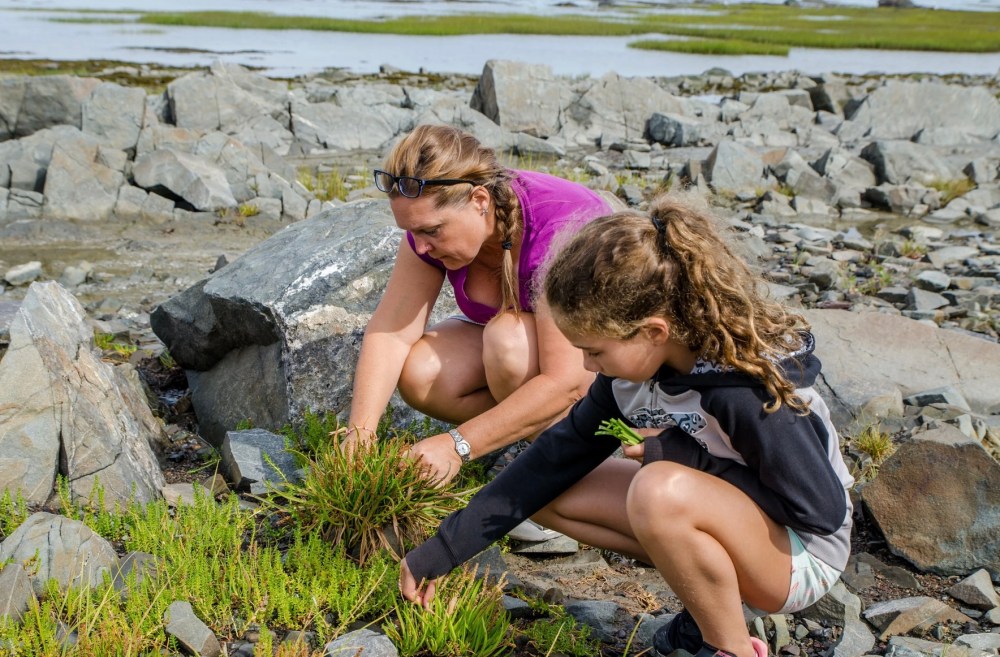
And when walking leads into the kitchen — when a plant identified along a stone wall later enters the Cooking Lab — the cycle of understanding closes. The body that walked is the body that tastes.
Landscape is no longer external. It is ingested.
Food Heritage and Ethnobotany in Portugal
Within Portuguese scholarship, Maria Manuel Valagão has significantly contributed to understanding wild edible resources as part of territorial identity. Her work highlights how ethnobotanical documentation and interpretative itineraries can preserve knowledge and strengthen cultural continuity.
Wild plants, in this perspective, are not incidental. They are embedded in collective memory and agricultural practice. Recording and identifying them becomes a way of safeguarding intangible heritage. We stand in dialogue with this intellectual lineage. Documentation matters. Interpretation matters. Transmission matters.
Yet we also ask: what happens after documentation? How does knowledge move from archive to activation?
Why Pico? Ecology, Scarcity and Adaptation
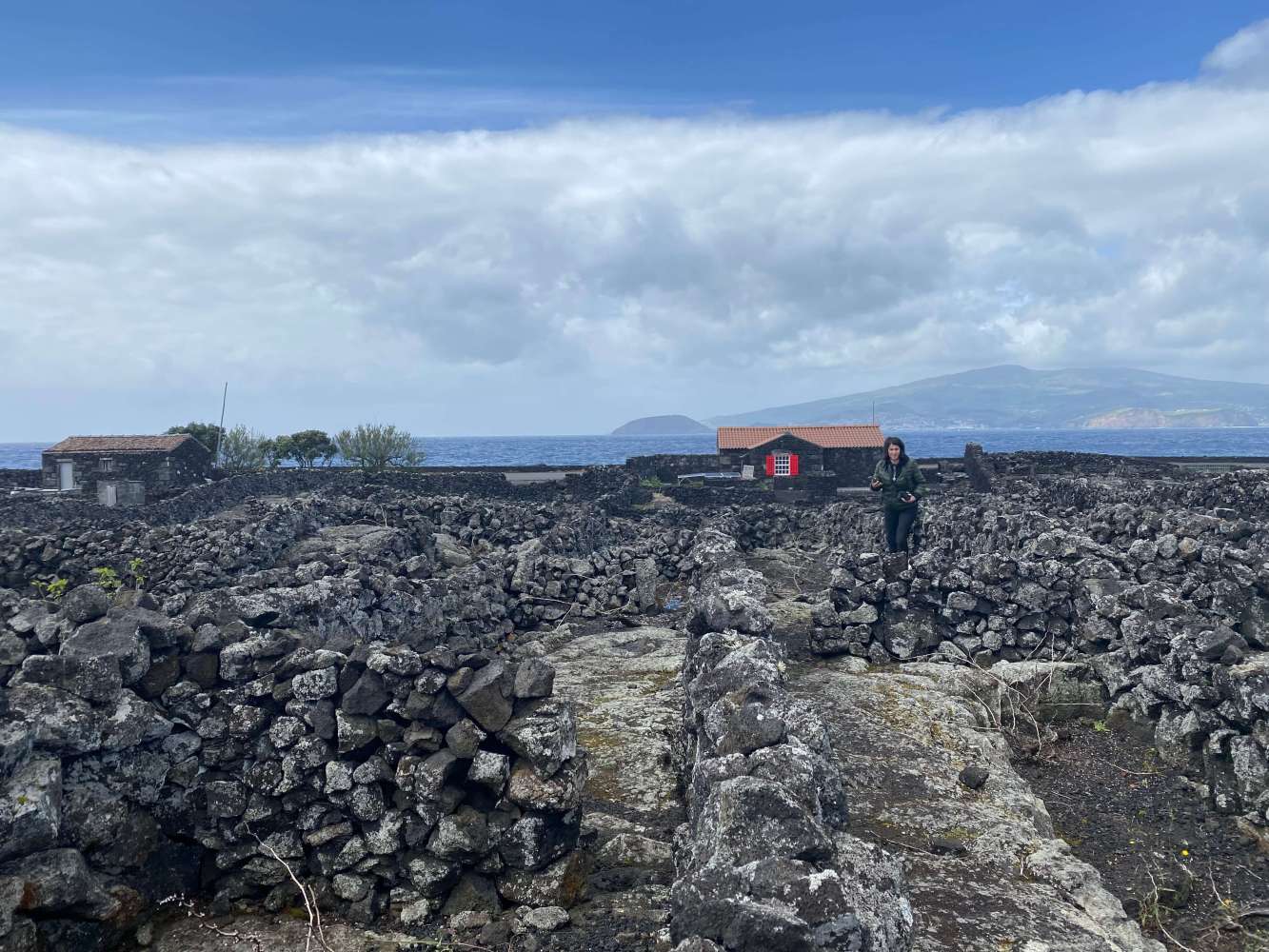
The landscape that bears witness to the scarcity of vegetation on Pico Island — yet one that the locals have skillfully transformed (2023) – José and Hélia beautiful house
Pico is shaped by volcanic stone and Atlantic wind. Its famous vineyards, protected by black lava walls, are perhaps the most visible expression of adaptation. But beyond cultivated fields lie spontaneous plants growing in abandoned plots, along coastal edges, within pastures, and between stones.
Historically, subsistence agriculture structured life on the island. Families relied on diversified gardens, seasonal cycles, and improvisation. Wild edible and medicinal plants often complemented cultivated crops. Knowledge circulated orally — through practice rather than manuals.
The sea further complicates this ecology. Marine resources, salt exposure, and migratory histories connect Pico to broader Atlantic networks. Food here is never purely terrestrial.
Our presence on the island is not temporary observation. We are embedded — living part of the year in Pico, maintaining professional and personal relationships, collaborating with residents. The Observatory Lab grows from this embeddedness. It is not an extractive research project but an evolving conversation rooted in affection and long-term engagement.
The Observatory Lab: A Hybrid Practice
The Observatory Lab is not a single-discipline initiative. It is a hybrid platform where anthropology, culinary practice, curatorial design, and community engagement intersect.
- Ethnographic Immersion
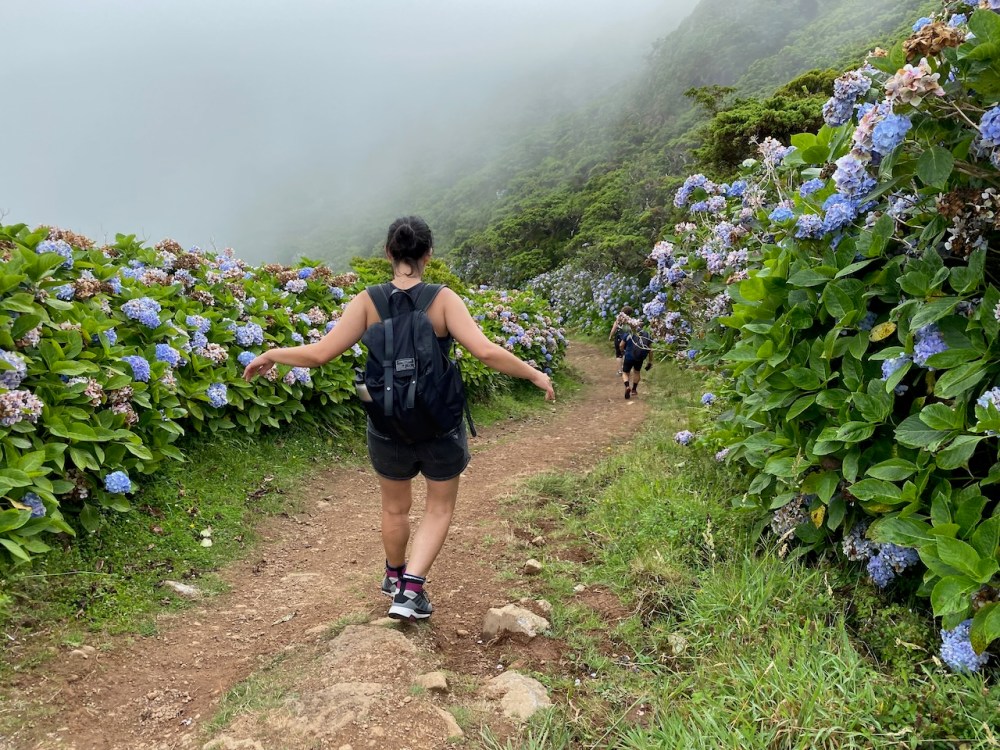
São Jorge Island exploring with our local friend Carlos and Zara Quiroga (2023)
With a background in anthropology, clinical psychology, journalism and cooking we approach the territory through listening. Ethnographic observation — attentive, relational, patient — allows us to understand not only which plants are used but how stories about them circulate.
We walk with residents. We observe harvesting practices. We document uses and contexts. We pay attention to silence as much as speech.
Knowledge is shared and co-constructed.
The introductory sessions, planned for March 2026, bring together locals, plant specialists such as Fernanda Botelho, mainland chefs such as Natacha Dias e local chefs and food enthusiasts — including voices from the vegan world such as Zara Quiroga. The goal is educational and exploratory: to expand plant literacy and activate creative adaptation.
- Curating Encounters
Our future walking routes intend to be designed encounters. They are curated sequences that invite participants to notice what is often overlooked: a plant growing at the edge of a path, a microclimate created by a stone wall, a seasonal shift in leaf texture.
Photography, sensory framing, and spatial design are part of this methodology. We are not only researchers; we are also experience designers. The route becomes a narrative.
 Cooking as Epistemology
Cooking is not an accessory to the project. It is a method of knowing.
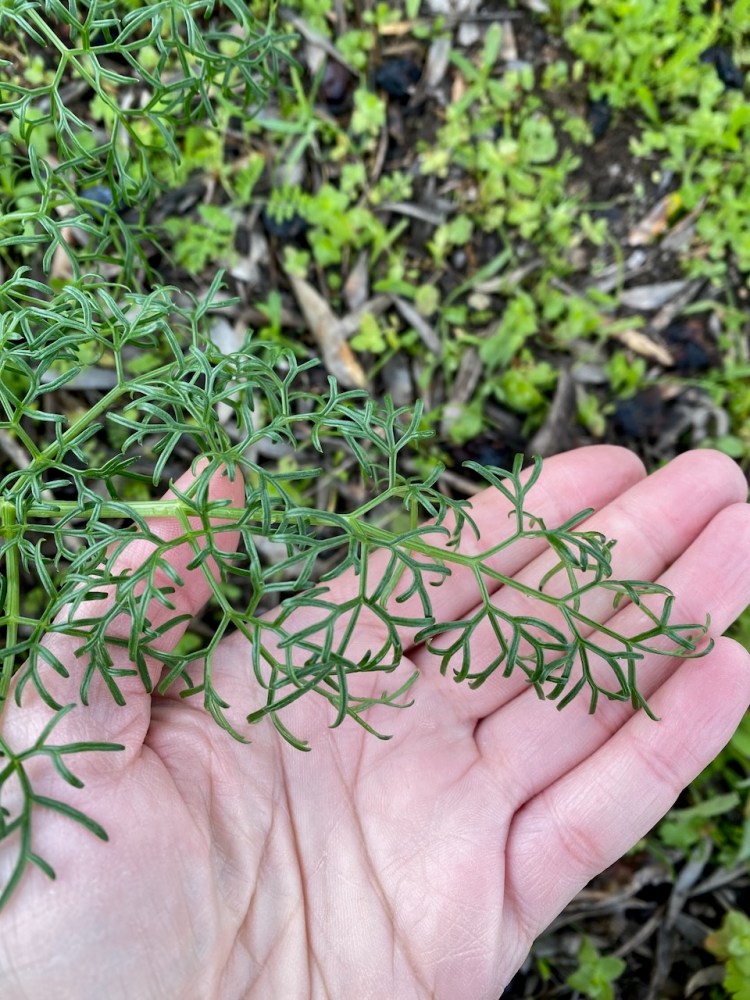
Through our Cooking Lab sessions, plants identified in the field are prepared, tested, tasted, and discussed. Culinary experimentation becomes a form of inquiry. What flavors emerge? How do textures change? How can traditional uses converse with plant-based innovation?
Cooking transforms theoretical understanding into embodied knowledge.
- Research With Consequences
The Observatory Lab is a research platform — but not purely academic. It is applied, hybrid, and relational. Its findings may lead to workshops, curated dinners, educational programs, or future food products inspired by the landscape.
We see no contradiction between intellectual rigor and entrepreneurial initiative. Ethical activation of local knowledge can coexist with carefully designed experiences that support both community vitality and sustainable tourism.
Toward a Living Foodscape
Small islands like Pico offer powerful lessons for contemporary food thinking. In a time of climate uncertainty and global supply fragility, spontaneous plants and localized knowledge systems regain relevance.
The Observatory Lab does not romanticize scarcity. Nor does it fossilize tradition. Instead, it treats the island as a living laboratory — where ecology, creativity, memory, and innovation intersect.
We read the landscape.
We walk it.
We cook with it.
We listen to it.
And in doing so, we participate in its ongoing transformation.
The foodscape of Pico is not only something to interpret.
It is something to inhabit, care for, and co-create.
Article by :
Sílvia Olivença (anthropologist and food guide/CEO at Oh! My Cod Ethnographic Food Tours & Trips)
Photos by:
Sílvia Olivença (anthropologist and food guide/CEO at Oh! My Cod Ethnographic Food Tours & Trips)
Want to more about Portuguese cuisine and its influences?
A guide to honey in Portugal: from the mainland to the Azores
Slow food and slow travel in Portugal: a guide to meaninful culinary adventures
Alentejo and Algarve: culinary traditions of the South of Portugal
Must do things in São Miguel island for food and wine lovers